>
Søg efter dato

2023

blog

A new documentary is a cry for decolonization across the Arctic

marts 22, 2023 • Af

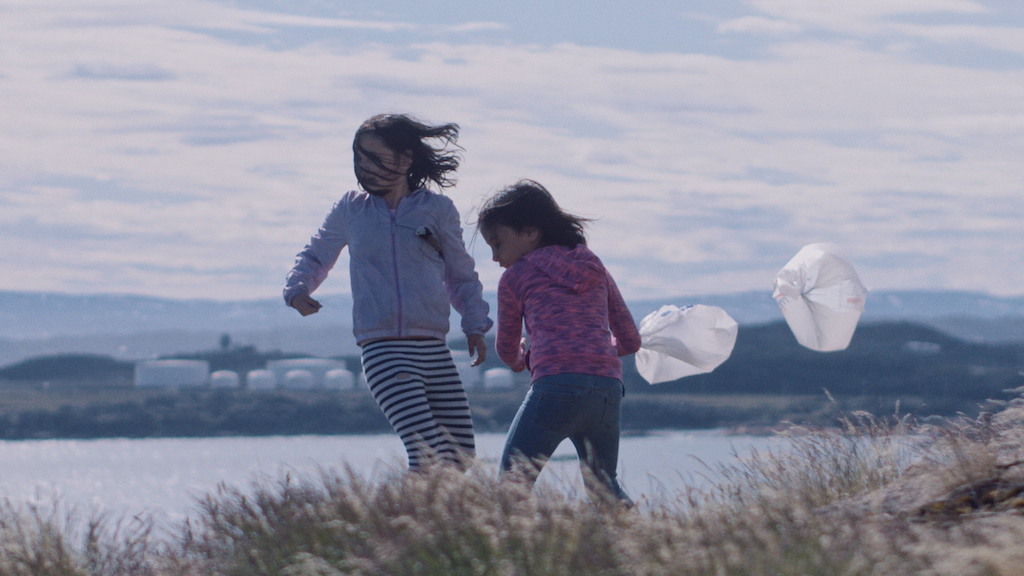
A still image from the new documentary film “Twice Colonized.” (David Bauer)

If you have been wondering what it feels to be colonized, to find that your land, your people, your body and mind have all been subjected to the will and whims of a foreign colonizer, Aaju Peter and the new documentary, Twice Colonized, in which she is portrayed, will most likely help.

Peter, who is Inuit, is trained as lawyer, and works as a human rights activist. She’s a powerhouse of anger, willpower and a the desire to raise others into alacrity and action. She has campaigned for decades for the rights of Indigenous peoples of the Arctic to hunt seals and received, in 2012, the Order of Canada. Today she is advocating the establishment of a formal, consultative Indigenous Forum within the European Union. In Iqaluit, Nunavut, where she lives, she teaches Inuktitut, the local Inuit language, to those who have lost it or never had it. She struggles for the cultural rights, land rights and all other rights of indigenous peoples whether in Greenland, where she was born, in Nunavut or elsewhere.

The loss

During the five years it took to shoot “Twice Colonized” Aaju Peter lost her young son to what appears to be suicide; a mindnumbing tragedy, a life ended far too early by a fall from the 10th floor.

You may, as I did, misunderstand the film as saying that it was this unbearable loss that propelled Peter to pursue, as she does, every available opportunity to take back her powers, her body and soul and to urge all of us — the colonizers as well as the colonized — to decolonize ourselves so that our children and grandchildren may hopefully live free from colonialisms restraints.

It is a tempting interpretation, but also, as I learn when we meet, a far too easy one.

“My fight started when I was 18. I had had enough of only being Danish, of only speaking Danish, of only doing everything the Danes wanted. I was so pissed off, I changed my name. I didn’t want anything to do with Danish or Denmark or anything,” Peter tells me.

She is in Copenhagen for the opening of Copenhagen Dox, one of Europe’s largest festivals for documentaries, where Twice Colonized featured as the lead show and received standing ovations. The film premiered in North America in January at the Sundance Film Festival in Utah and will continue to festivals in Canada and elsewhere.
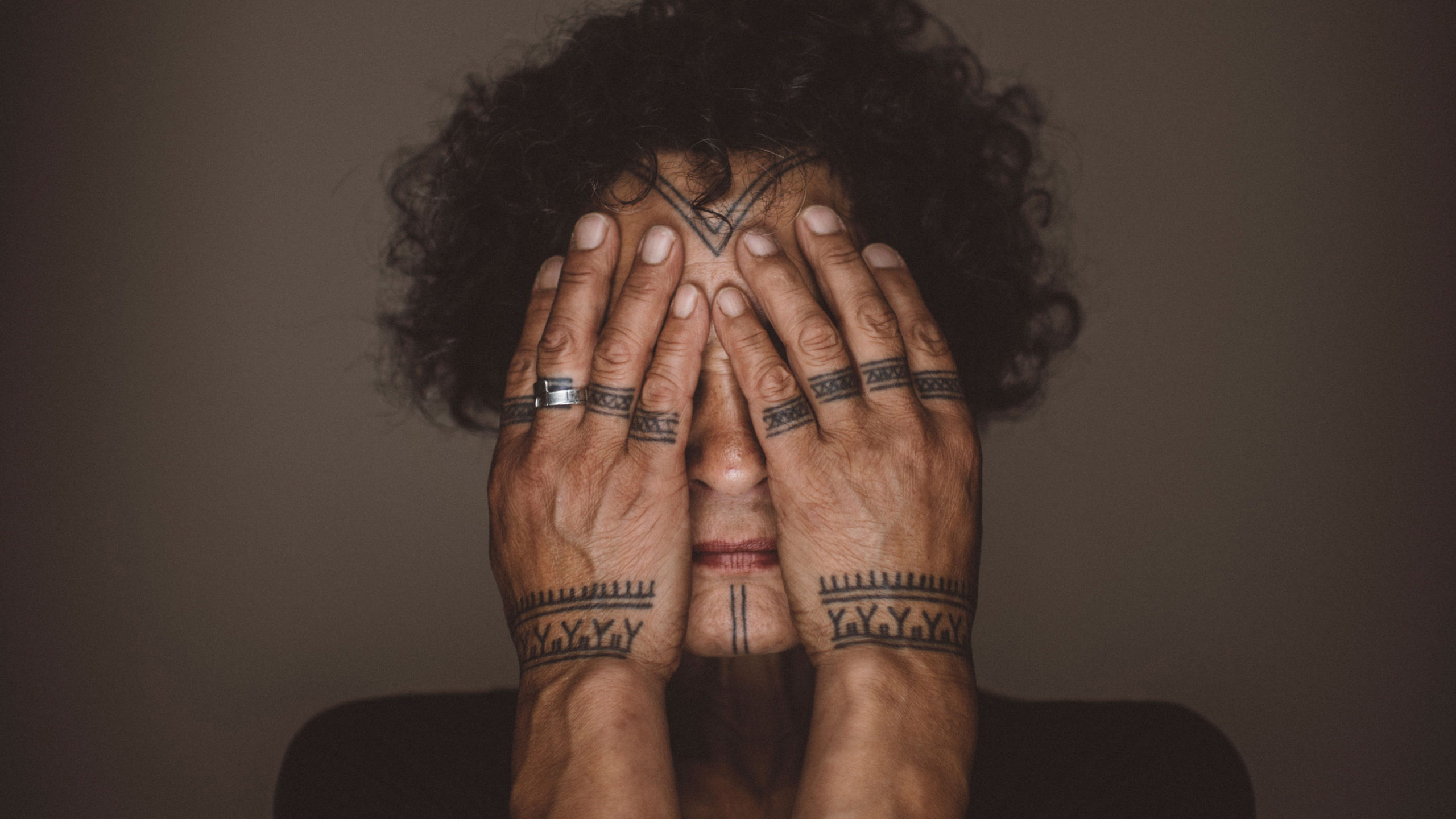
The film “Twice Colonized” documents the decolonizing work of Aaju Peter, an Inuit lawyer from Greenland who lives in Nunavut. (Angela Gzowski)

It is all about colonialism and how it affects the individual:

“Some white people say to me, ’hey, but you got something good out of it. You have a good education and all these nice experiences.’ And okay, I say, that’s probably fine from where you’re standing, but I’m telling my story and how it affected me,” Peter tells me.

“I was born into a Danish colony, even though Denmark didn’t want to call it a colony. And it’s not only the land that is colonized. It’s the person, the people and their minds.”

At the age of 11 she did well in school and was put on a plane from Greenland to Denmark, as many other young Greenlandic children at the time. The idea, very much a colonial concept, was that the children would learn Danish, be cultivated, educated and returned to Greenland to lead their nation into a brighter future. To Peter, who stayed in Denmark until she was 18, the passage turned into debilitating loss:

“I had to learn a new way of thinking, a new way of expressing anything. A different culture, different people, different heritage. That’s how I ended up speaking Danish and when I went back to Greenland, I couldn’t speak my own language. My mind and my thinking was so colonized,” she says.

She found herself unable to reconnect meaningfully with her family and community. Instead, she left. She met an Inuit from Nunavut and followed him to Iqaluit, which seemed as far away from Denmark as she could get.

“I moved to the Canadian Arctic which was colonized by the Canadian state, so now I was twice colonized. That’s where the title came from,” she says.

From the screen we learn that Peter later partnered with Marcus, a white Canadian and then broke up with him again. The film evokes much love and longing, but also obnoxious abuse and pain. The viewer never meets Marcus in the flesh, only as a manipulative and accusing voice on Peter’s mobile phone.

“I had to learn English and I took my law degree in English. That became my third identity, and then I had to deal with the English-speaking state and live with southern white people, which became a fourth form of identity. So I am a living, breathing quadrilingual and quadricultural person. If you are looking for the meaning of colonization and being colonized it is when all your autonomy is taken from you by a foreign state, a foreign language, and when foreign cultures and customs are imposed on you,” she says.

The demons

By the film’s promotion material we are told that Peter is “on a personal journey to confront the demons of her past,” but she is surely also very much concerned with the present. On screen she dances riotously to rock music, she cries and laughs, obviously determined to live, feel, speak, journey and act as she must. At one point in the film, she seems to collar any demons she might still be harboring and expertly bends them to her own devices: “Your experience is your power,” she exclaims.

Peter wants to turn also the more painful elements of her past into dialogue and change, not into additional anger or rage. She points at colonialism as the source of so many current ills, including the many suicides in Nunavut and in Greenland, but she urges dialogue, not conflict or confrontation. She wants to assist others who feel trapped, as she has felt trapped, by colonialism past and present. She strives to include, not exclude, as many as possible in the decolonization process:

“In Canada the buzzword is reconciliation. We have to do it in a kind and open way. Be kind to each other. There was a lot of hurt and there are so many assumptions. And we don’t want that. We have to listen to each other, not make it personal: ‘It was your fault’ or ‘you did this and you did that’. No, that’s out, that is not permissible. We need kindness, humility and patience. Kindness and understanding is my goal,” she tells me.

On screen she coins a catch-all: “It’s not about why it happened, it is about how we make it stop.” Not that she wants to obliterate the past or paint it in rosier colors; on the contrary. In the film she journeys to Denmark to revisit her past and she travels with her brother to Nanortalik in southern Greenland; a painful recollection of a rough childhood and an angry father. Hunger was close and discarded fruits from the dump part of the diet. She seeks to acknowledge the past, but as a window to a better future:

“I think many of us just stop there because the ‘how-to-stop-it’ is just too much work. We see suicide happening all over. We see homelessness everywhere. We see abuse. We see so many injustices in our everyday life. But do we do something about it? No, we go, ‘oh, I’m too busy’,” she says.

On screen she writes the first sentence of a book: “Is it possible to change the world and mend your own wounds at the same time?”

She travels extensively, and seeks out any and all that might inspire her or be inspired themselves. She calls on other Inuit in particular, but also on many others, including a Sámi community in northern Sweden. She embraces the young, the old, politicians, students and all in between:

“It is really up to you. It’s up to us to do something. If we all decided to put in one, five or ten percent of our everyday life to do something with issues that we care about we could move mountains,” she says.

“That’s what I would like to see. It’s not good enough to just say something. There’s way too many people who just say something and don’t go past that.”

“Twice Colonized” (92 min.) by Lin Alluna (Denmark), written and lived by Aaju Peter. “Twice Colonized” was filmed in Nunavut, Canada, Greenland, Denmark, Brussels,  New York and in a Sámi community in northern Sweden. Produced by Emile Hertling Péronard, Alethea Arnaquq-Baril, Bob Moore and Stacey Aglok Macdonald, a team bridging both Greenland and Nunavut. ÁNORÂK FILM, RED MARROW MEDIA, EYESTEELFILM and REEL PICTURES.

This text was first published on ArcticToday.com on March 22, 2023

blog

Russia gets approval for much of its Arctic Ocean seabed claim

marts 1, 2023 • Af
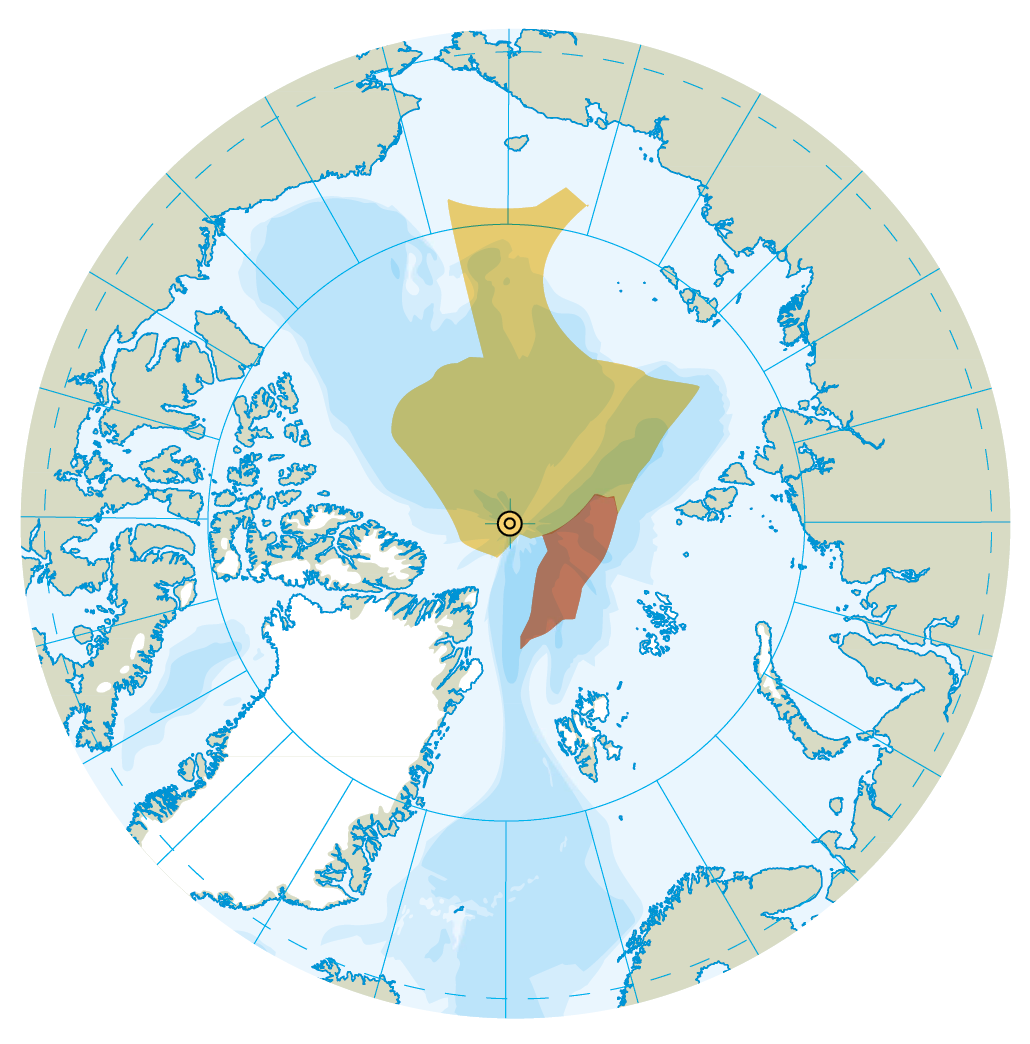
A map of the Arctic Ocean shows the approximate extent of the area where the UN CLCS approved the data associated with Russia’s claim (yellow) and for which it requested more information (brown). This coverage of the CLCS’s approval – which appeared in Weekendavisen in Denmark and on ArcticToday.com in the US – became the first media coverage of the event in the world. (Andreas Peretti / Weekendavisen / DK)

After more than 20 years of extensive diplomacy and expeditions with icebreakers, research vessels and submarines under the polar sea ice, Russia has received approving recommendations of the majority of its claim to the rights to the seabed in the central parts of the Arctic Ocean from the UN’s Commission for the Limitation of the Continental Shelf, the CLCS.

The CLCS, a body under the UN Convention of the Law of the Sea and the prime international authority on the rights of coastal states to the seabed beyond their maritime borders, reached that conclusion on February 6 in New York. Russia’s war in Ukraine has not halted the processing of its claim.

We do not know all the details, but the CLCS has released a 63-page summary. A qualified estimate based on the accompanying maps indicates that Russia has got the CLCS’ approval — or “recommendations” — of data and measurements in support of a claim for approximately 1.7 million square kilometers of seabed in the central parts of the Arctic Ocean. This is an area the size of France, Italy, Germany and Spain combined.

The CLCS’s recommendations of the Russian data and methodology are not the final words in the international discussion on the rights to the Arctic seabed, but the CLCS has now validated the majority of Russia’s claim.

The Russian claim — or “submission” in CLCS terminology — stretches from Russia’s exclusive economic zone in the waters north of Russia across the North Pole until it reaches the exclusive economic zones of Canada and Greenland, which is part of the Danish kingdom.

In the seas north of the Bering Strait and Alaska Russia’s claim stops at a straight line defined by a separate agreement with the U.S. from 1990 which delimits the territorial sea and continental shelf between the two nations.

Only a smaller portion of Russia’s claim, approximately midway between the North Pole and the Russian islands of Franz Josef Land and Novaya Zelma (see map above) was not, at the time of the CLCS final considerations, sufficiently documented in the eyes of the commission. Instead, the CLCS invited Russia to provide additional information, which Russia then did in a partially revised submission on February 14. The CLCS’s processing of this new information is now pending.

Strength and wealth

Russia has not issued any public statement in response to the recommendations from the CLCS, possibly because of the last outstanding issues, but the commission’s conclusions have long been anticipated. For more than two decades the government of president Putin has illustrated a strong interest in these developments.

Through its accumulated claims for some 75 percent of the seabed in the international parts of the Arctic Ocean, including the North Pole and its powerful mythology, Moscow has signaled its perceived strength and robustness to the Russian public and to the world. Several previous leaders of Russia and the Soviet Union have used the conquest of the Russian Arctic for similar projections of power and strength.

Only four days before the announcement of the CLCS’s recommendations of Russia’s claim, Russian President Vladimir Putin headed a discussion within Russia’s Security Council on the Arctic seabed.Exports of oil and gas from land based or offshore facilities in the Russian half of the Arctic already play a significant role in the Russian economy and for its ability to sustain its military invasion of Ukraine. The vision of still more riches from new parts of the Arctic seabed may possibly help bolster additional faith in the future of the Russia’s government, even if Western geologists have largely dismissed the idea of commercially viable oil and gas in the Arctic Ocean other than in the more shallow waters in the existing exclusive economic zones of Russia and other Arctic states.

Ministers from Putin’s government have attended several of the 30 some meetings held by CLCS and its relevant subcommittee in New York to discuss Russia’s claim.

Russia submits claim on the North Pole to UN – but oil aspirations seem dead in the water - Bellona.org


Meanwhile, parachuting Russian troops have practiced at the North Pole and in 2007 president Putin issued medals when two small Russian submarines planted a Russian’s flag on the seabed at the North Pole some 4,300 meters below the surface. In the run-up to the winter Olympic Games in Russia in 2014, a Russian vessel brought  runners and the Olympic Torch Relay to the North Pole, and orthodox priests have also blessed Russia’s Arctic endeavors at the North Pole.

It seems likely, therefore, that Moscow will celebrate the recommendations of the CLCS, and they will most likely be seen as a substantial victory for Russian science and technology.

As the Danish geophysicist Christian Marcussen, a former senior advisor of the Geological Survey of Denmark and Greenland and Project Leader of the Greenland parts of the kingdom of Denmark’s continental shelf project from 2003 to 2015, told ArcticToday: “If I had used decades on this case for Russia, I would call this a really impressive result of my life’s work”.

The contest continues

The CLCS’ recommendations of Russia’s claim should not be misread, however. The broad partial approval of Russia’s claim does not mean that Russia has now won the rights to the disputed parts of the Arctic seabed.

The Kingdom of Denmark (on behalf of Greenland) and Canada have also filed substantial claims with the CLCS and these are still waiting for CLCS evaluation.

Norway has filed claims in other parts of the Arctic Ocean and the U.S. reportedly has prepared, but not yet submitted to the CLCS, claims reaching from the waters north of Alaska towards the North Pole.

The claims of Canada and the Denmark/Greenland both overlap substantially with Russia’s and the UN Convention of the Law of the Sea stipulates that in such cases any disagreement about the final borders will have to be settled by the states themselves.

The CLCS will evaluate whether the claims of each state is supported by sufficient data and correct measurements but the CLCS will not serve as arbitrator, if any other state — say Canada —  provides data to prove that the seabed in question connects to its continental shelf in the same way it connects to Russia’s.

“The CLCS in its summary explicitly explains that the CLCS will not determine how the pie should finally be delimited. It does so precisely to avoid misunderstandings,” Marcussen told ArcticToday.

Large overlaps

The Danish Kingdom’s claim to the seabed in the Arctic Ocean amounts to some 895,000 square kilometers. According to the Institute for Border Research at the University of Durham in Great Britain it overlaps with Russia’s claim by some 800,000 square kilometers. Canada’s total claim in the Arctic Ocean amounts to some 2.03 million square kilometers out of which some 1.5 million overlap with the Russian claim.

With the CLCS’ recommendations of Russia’s claim now at hand it seems more likely than ever that Danish, Greenlandic and Canadian diplomats will eventually meet with Russian counterparts to negotiate over very large tracts of seabed.

Previously, some observers have doubted whether the governments involved had sufficient data to substantiate the far reaches of their claims, but this doubt should now be waning.

The CLCS in its evaluation of Russia’s claim seem to accept largely Russia’s use of subsea mountain ranges in the Arctic Ocean as a departure point for its claim, something that has not previously been confirmed. This makes it more likely that  large parts of the claims by Denmark/Greenland and Canada will also meet the approval of CLCS.

The CLCS’ decision has reportedly been reached by consensus. To Bjørn Kunoy, a professor of international law and special legal counsel to the foreign service of the Faroe Islands, who has advised Greenland and other states in similar cases, this is noteworthy.

“The conclusions are strengthened by the consensus,” Kunoy told ArcticToday. This will benefit, he finds, all involved as it makes unlikely future challenges to the conclusions.

Kunoy also points towards the time frames involved. Most observers expect that the CLCS will find time to deal with the claim of the Danish Kingdom only by 2032 or later and that Canada will have to wait even longer. Other nations have filed earlier submissions to the CLCS and will be dealt with first.

In the interim, all parties including Russia will have to wait. Despite their largely approving nature, the CLCS’s recommendations of Russia’s claim does not give Russia license to operate on the disputed seabed.

”The point of fact that the submissions of the other contender states will only be considered at a later stage does not in any way challenge their entitlements, also where these will overlap with the area that falls within the entitlement of Russia,” Kunoy explains.

Some observers have speculated that Russia in the coming years of waiting may get so accustomed to regard the dispute as settled in its favor that the final negotiations on the subsea borders will be more difficult.

In the meantime, there are no known indications that Russia will abandon its adherence to the UN rules for peaceful delimitation of the Arctic seabed. Since 2001, Russia has followed the relevant regulations as stipulated by the UN Convention of the Law of the Sea. Moscow has accepted on an ongoing basis the CLCS’ admission of claims to the Arctic seabed by other states and that the CLCS will eventually deal with these as it has now dealt with Russia’s.

As this article was published on ArcticToday.com  27 February 2023 it marked the first media coverage in the world of the CLCS’ decision. 


blog

Grønlands forfatningsudkast bliver det første detaljerede bud på et uafhængigt Grønland

februar 7, 2023 • Af

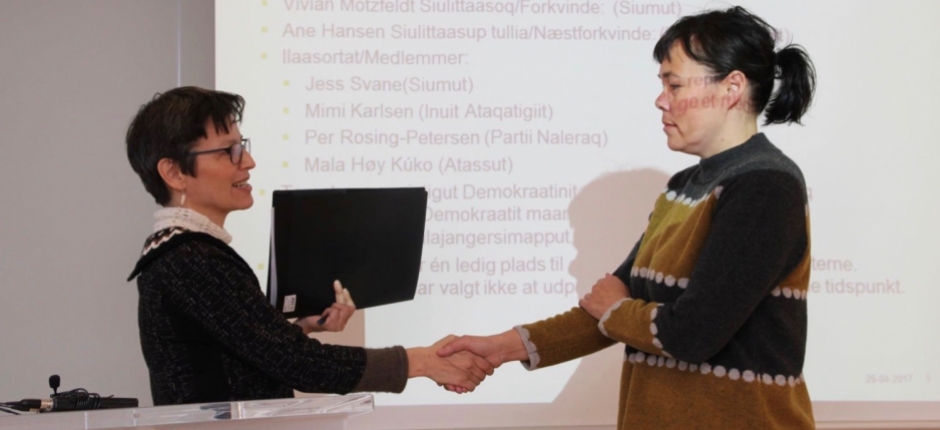
Grønlands første og hidtil eneste Selvstændighedsminister Suka K. Frederiksen (tv) med den første formand for Grønlandsforfatningskommission Vivian Motzfeldt i 2017 (Foto: Grønlands Selvstyre).

Det begyndte i Nuuk en grå lørdag i november 2016.

Mødet var hasteindkaldt, publikumsrækkerne pakket til sidste stol. Udenfor i mørket foran Inatsisartut, det grønlandske parlament, lå bunker af våd sne, men stemningen i parlamentssalen var glædesfuld og varm.

Det hele kulminerede, da de fleste af parlamentsmedlemmerne til sidst spontant sprang op og klappede.Efter mere end ti års tilløb havde et flertal stemt i flok: Grønland skulle have sin egen forfatning. Under forhandlingerne havde den politiske veteran, tidligere landsstyreformand Lars-Emil Johansen ligefrem læst højt af ‘Sinnattugaq’, ‘En grønlænders drøm’ af Mathias Storch, Grønlands første roman fra 1914:

“Døren er nu åben, træd indenfor og begynd arbejdet. Den, der arbejder, får sin løn med Guds nåde.”Kritikerne advarede om, at det gik for hurtigt. Detaljerne var ikke på plads, sagde de, men det stoppede ikke processen. En måned forinden havde en ny koalitionsregering i Nuuk forklaret pointen i sit regeringsgrundlag:“Grønland er uigenkaldeligt på vej mod selvstændighed, og denne proces kræver ikke alene politisk stabilitet, men også national samling. Parterne er enige om at fremføre forslag til en ny forfatning ved udgangen af denne valgperiode.“

Helt så hurtigt gik det ikke, men nu sker det angiveligt: Naalakkersuisut, det grønlandske landsstyre, har meddelt, at den grønlandske forfatningskommission, nedsat i 2017, sigter efter at levere et udkast til Grønlands fremtidige forfatning 1. april i år.

Går det som planlagt, kan vælgerne i Grønland og alle andre se frem til det første konkrete og samlede bud på, hvilken slags land der sigtes mod, når man i Grønland taler om uafhængighed, løsrivelse og statsdannelse.

Hvem vil være de naturlige statsborgere i det frie Grønland? Hvilken relation vil Grønland have til Danmark? Hvad med sproget? Vil private kunne eje land, eller vil alt land stadig tilhøre fællesskabet? Får naturen særlig status? Hvordan skal landet regeres, forsvares og forvaltes?

Delte meninger i Grønland

Kritikere i Grønland, herunder Grønlands gamle liberale parti Atassut, har stemplet forfatningsprocessen som dyr og overflødig. Atassut ser gerne, at rigsfællesskabet med Danmark fortsætter, og partiet trak sig helt ud af forfatningsarbejdet i 2021. Andre hylder til gengæld forfatningsprojektet som helt centralt for afklaring af Grønlands egne mål og værdier.

Erik Jensen, formand for Siumut, Grønlands for tiden næststørste parti, og viceformand for Grønlands regerende koalition, lød begejstret, da jeg mødte ham til Naalakkersuisuts nytårskur i København i forrige uge:

“Det gælder om at få befolkningen inddraget og debatten i gang om, hvordan landet skal styres fremadrettet. Vores partis program er jo, at vi skal blive selvstændige og herrer i eget hus. Det er den store ambition og en del af målsætningen med det her. Vi har store udfordringer i Grønland, og vi skal træffe de rette beslutninger på det rette tidspunkt, men vi tænker langsigtet,” sagde han.

Arbejdet med den nye forfatning

Stort set intet om indholdet af Forfatningsudkastet er endnu sluppet ud. Arbejdet er i perioder gået rigtigt stærkt, det er alt, vi ved. Først når udkastet formelt er overdraget til Naalakkersuisut, vil offentligheden blive inddraget, og forfatningsudkastet sat til debat i Inatsisartut.

Hvad der herefter skal ske, er ikke klart, men at dømme ud fra den hidtidige politiske debat i Grønland, er det ikke de ledende politikeres plan, at en færdig grønlandsk forfatning nu snarest skal til folkeafstemning, vedtages og sættes i kraft.

På Færøerne rumlede Lagtinget i årene frem mod 2018 med planer om en færøsk forfatning, der skulle fungere i parallelløb med den danske grundlov. Den daværende Lars Løkke-regering mente længe, at det ville være i strid med grundloven. Flere udkast måtte revideres før de danske jurister var tilfredse, nye vanskeligheder opstod i Thorshavn, og Færøerne har stadig ingen egen forfatning.

I Grønland kender man selvsagt de færøske vanskeligheder, og debatten hidtil tyder ikke på, at en fiks og færdig, vedtaget og ikraftsat grønlandsk forfatning nu vil være sigtet på den korte bane. Et forfatningsudkast vil muligvis inspirere til udvalgte forandringer i forholdet til Danmark, men næppe til et parløb eller opgør med den danske grundlov i nærmeste fremtid.

Det nye vil være, at Grønland nu, hvis alt går som planlagt, i fremtiden vil have egen forfatning mere eller mindre klar til ikrafttrædelse den dag, oprettelse af en uafhængig grønlandsk stat måtte blive aktuel. Det er tilhængernes håb, at det vil styrke uafhængighedsprocessen.

Et lovgrundlag i tråd med grønlandske værdier

På Christiansborg vil forfatningsudkastet næppe skabe tumult. Siden Selvstyrets indførelse i 2009 har det stået Grønland “frit for at indlede en forfatningsforberedende proces,” som det hedder i Selvstyrelovens bemærkninger. Tunge problemer opstår først, hvis forfatningsudkastet ophøjes til lov, og den danske grundlov udfordres. Det er der som nævnt næppe udsigt til, uanset at mange i Grønland har et problem med grundloven.

Rigets reviderede grundlov fra 1953, der afsluttede kolonitiden og gjorde Grønland til en del af Danmark og grønlænderne til danske statsborgere, blev født ved folkeafstemning i Danmark, men uden folkeafstemning i Grønland.

Siden har utilfredsheden gæret, og i 2004 var den daværende formand for partiet Inuit Ataqatigiit Josef ‘Tuusi’ Motzfeldt blandt de første til at formulere ønsket om en grønlandsk forfatning:

“Det grønlandske sprog, vor identitet, rådighedsret til landet og vor kultur nyder ikke direkte beskyttelse i den danske grundlov. Det grønlandske folk skal derfor have egen grundlov frem for et forfatningsmæssigt lovgrundlag, som vi føler at have til låns fra Danmark. En grundlov for os som giver udtryk for det grønlandske folks identitet – såvel indadtil som udadtil,” skrev han.

Knaster i kommissionsarbejdet

Forfatningskommissionen består af folkevalgte politikere, der har trukket på nogle få akademiske eksperter, herunder den islandske ombudsmand (Island, der fik egen grundlov i 1874, løsrev sig endeligt fra Danmark under 2. verdenskrig og betragtes på mange måder som foregangsland i Grønland).

Forfatningsprojektet har undervejs været plaget af kontroverser og regerings- og personudskift. Af de oprindelige syv kommissionsmedlemmer er der ingen tilbage, og sekretariatet er tilsvarende forvandlet. Mandatet fra 2017 måtte skrives om, og et kontroversielt forslag om løn og embedsbolig til formanden fik for en tid arbejdet til at grundstøde. I januar 2022 blev den tidligere formand for Naalakkersuisut Kuupik Kleist udpeget til formand for Forfatningskommissionen, men han trak sig efter mindre end fire måneder, angiveligt i frustration over manglende fremdrift.

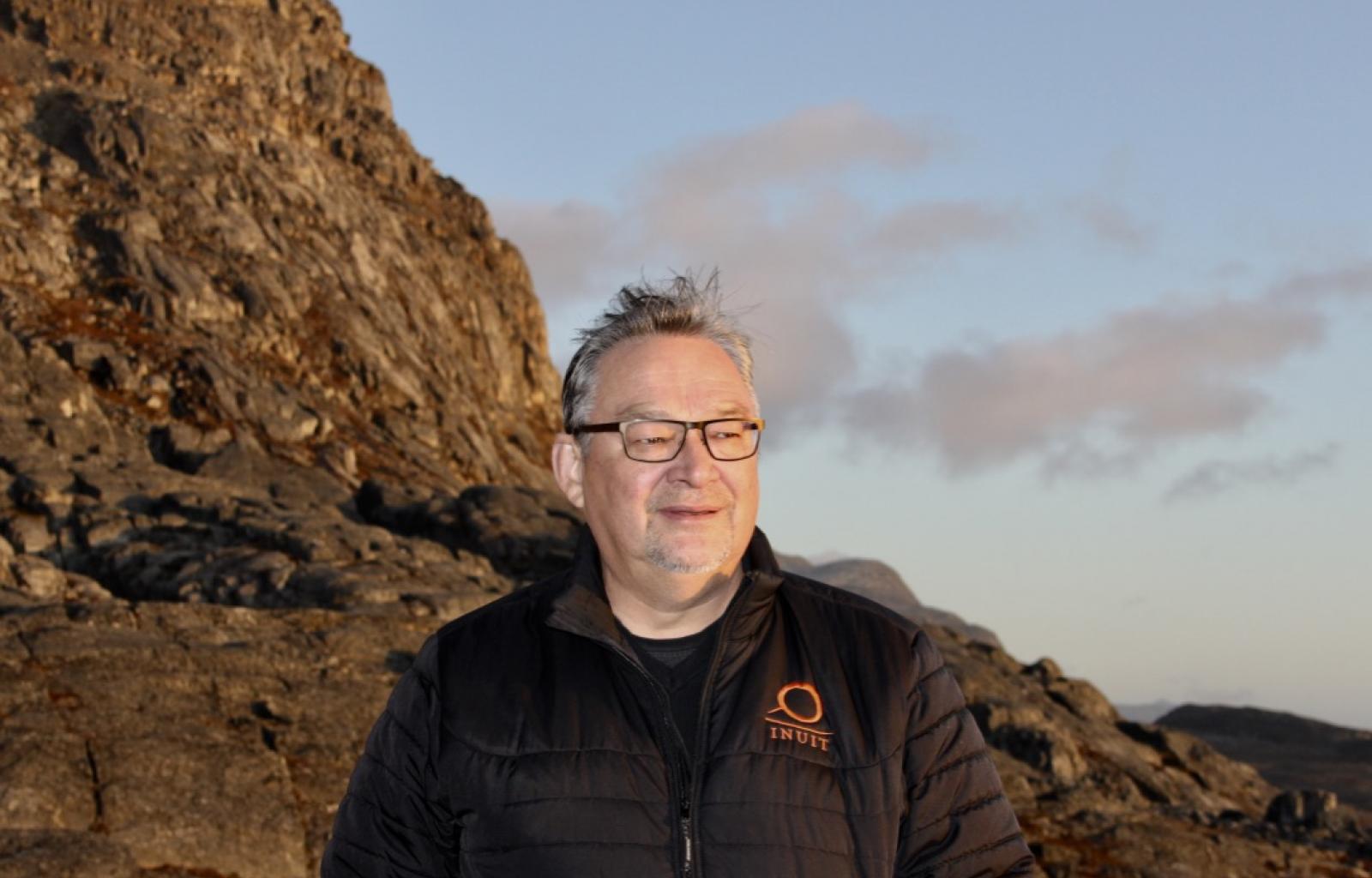
Kuupik Kleist, tidl. formand for Naalakkersuisut, trak sig fra formandsstolen i forfatningskommissionen efter knap fire måneder. Foto: Marc Jacobsen

I sidste uge kunne nyhedsmediet Sermitsiaq.ag så fortælle, at Naalakkersusisut har mistanke om misforvaltning af Forfatningskommissionens finanser, og en revisionsundersøgelse vil nu løbe parallelt med kommissionens afsluttende arbejde.

Forfatningskommissionen har arbejdet på grønlandsk (med tolk til den islandske rådgiver), men forfatningsudkastet og den medfølgende betænkning udkommer ifølge sekretariatet i Nuuk på både grønlandsk og dansk.

Forfatningskommissionen har før overskredet en deadline, men denne gang er givetvis anderledes. Naalakkersuisut har ikke afsat penge til mere arbejde i Forfatningskommissionen på Finansloven for 2023. Slutspurten gennemføres på resterne fra 2022.

Denne text blev offentliggjort første gang på Altinget / Arktis 30. januar 2023


blog

Canada extends its Arctic Ocean seabed claim all the way to Russian waters

januar 25, 2023 • Af

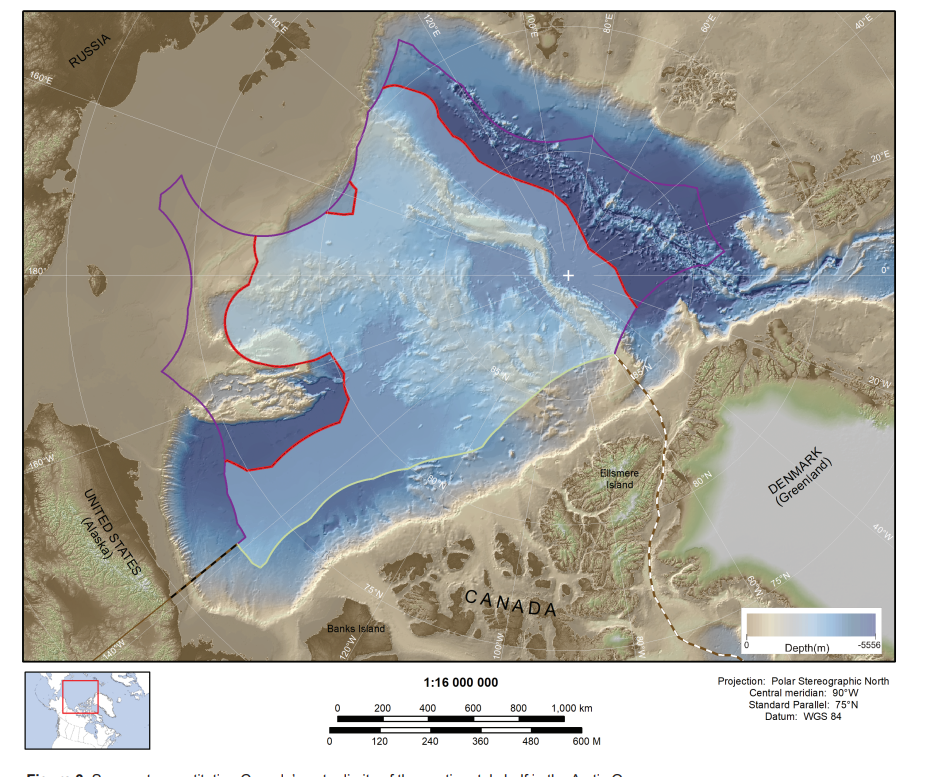
A map from Canada’s addendum to its Arctic Ocean seabed claim shows the updated boundaries.
Canada’s claim now extends all the way to Russia’s territorial waters

In an addendum filed in late December 2022, Canada substantially expanded its claim to the Arctic Ocean seabed. Canada’s claim now reaches in several places all the way to Russia’s exclusive economic zone.

The changes to the claim were delivered as a 54-page note, or addendum, to the UN’s Commission on the Limits of the Continental Shelf. The extension is now added to Canada’s original claim from May 2019.

Three accompanying maps show how Canada’s full claim now stretches along the length of the Lomonosov Ridge, a steep sub-sea mountain range to the west of the North Pole, to the limits of Russia’s exclusive economic zone 200 nautical miles from Russia’s coastline. A conservative estimate based on the three maps included indicates that Canada has extended its claim by some 600,000 to 700,000 square kilometers.

The Canadian claim is filed at a time when relations with Russia in the Arctic are severely strained because of Russia’s war on Ukraine. All collaboration with Russia within the Arctic Council, the main inter-governmental body in the Arctic region, is currently paused with no prospect of resuming soon.

Consultations with Russia

The original Canadian claim or submission from 2019 already overlapped with Russia’s claim to the seabed and also with a joint Greenlandic-Danish claim. The Canadian addendum filed with the CLCS on December 19 does not specify how large the overlaps are now, but the accompanying maps indicate that they have grown substantially.

The Canadian extension follows a claim by Denmark-Greenland from 2014 that stretches from Greenlandic waters to Russia’s exclusive economic zone and several extensions of Russia’s original claim from 2001. Russia has claimed in total some 75 percent of the seabed in the central parts of the Arctic Ocean — all according to regulations stipulated by the UN Convention of the Law of the Sea, which regulates the delineation of the seabed in international waters.

Claims to the CLCS may provide the claimant government with exclusive rights to exploit any resources on or under the seabed, but not any substantial privileges in the water column or above it.

Regular meetings between Canada, Russia and Denmark/Greenland at scientific as well as diplomatic level have been held to prevent any conflict, and Canada in its note of December 19 explains that “regular consultations” have been held with Russia during its preparation.

Some western analysts have worried that Russia, which planted in 2007 a much publicized flag on the bottom of the Arctic Ocean, might abandon its adherence to the UN Convention of the Law of the Sea, but no significant moves by Russia to do so have been publicly recorded.

The claims of the three nations will be evaluated by the CLCS’s international panel of experts. The CLCS will evaluate to what extent scientific data submitted by the three nations are sufficient to prove that their continental shelves extend into the Arctic Ocean to the degree their governments claim. The CLCS, however, is not mandated to decide on the final delineation of the seabed. According to the UN Convention of the Law of the Sea, the final delineation of the seabed — including that around the North Pole — should eventually be decided through negotiations among the nations involved.

The CLCS’s evaluation of the claims of all the three nations involved is expected to be finished only in a decade or more. An evaluation by the CLCS of Russia’s claims is expected in 2024, but due to a long queue of other claims from other parts of the world, an evaluation of the Danish-Greenlandic claim is expected only in eight to 10 years from now and an evaluation of Canada’s claim even later.

First published on ArcticToday.com 21. December 2022.