Greenland drops cooperation with Russia on fish while the Faroe Island continue controversial quota swaps
december 14, 2022 • Af Martin Breum
Tuesday last week, as discreetly as possible, Greenland delivered a highly unusual message to Moscow.
Greenland will not use its fisheries agreement with Russia to fish for cod and other fish in the Barents Sea in 2023 and no Russian fishing vessels will have access to the usual quotas of halibut and other fish in Greenland’s waters.
It’s the first time since 1992 — when Greenland and Russia signed a formal deal to swap fishing quotas — that this deal will not lead to talks and a new agreement on quota-swapping for the coming year.
The message to Moscow does not contain, as far as information from the authorities in Nuuk goes, any wording on or protest against Russia’s war in Ukraine. Asked for details, the Department of Fisheries and Hunting of Greenland’s government in Nuuk offers as an explanation only that the fish stocks in Greenland’s water are presently not sufficient to allow for the usual quota swapping with Russia.
There are, however, indications that a silent protest against Russia’s war in Ukraine may be involved.
Greenland’s distinct denouncement of Russia’s war has been communicated on several other occasions.
On February 25, just a day after Russia’s invasion of Ukraine, Greenland Premier Muté B. Egede issued a blunt press statement: “I forcefully condemn Russia’s acts against the Ukrainian people. They are senseless and for that reason we want to demonstrate our solidarity with the people of Ukraine with our adherence to the international sanctions on Russia,” he said (my translation).
In the same move, Greenland’s large publicly owned fishing-enterprise Royal Greenland was ordered to deactivate its activities in Russia, and its CEO Mikael Thinghuus promptly followed up: “Individual needs have to bow to the greater good, and commercial pain is nothing compared to the pain the Ukrainian population is suffering,” he told Sermitsiaq.ag, Greenland’s leading news site.
Royal Greenland has since put up for sale its share of Agama Royal Greenland, a packing business in Russia, which for 25 years has packed and sold Greenland fish and shrimp in Russia. Polar Seafood, Greenland’s largest private fishing company, has also sold off its interests in Russia. Prior to the war in Ukraine, exports to Russia accounted for some 13 percent of Greenland’s total exports.
In October, Egede made clear his continued opposition to the Russian invasion of Ukraine in front of some 2,000 international attendees at the annual Arctic Circle conference in Reykjavik: “The government of Greenland condemns the brutal war on Ukraine and Russia’s disregard for international law and order. We clearly stand with the western alliance in this question. Greenland will impose the EU sanctions towards Russia and Russian entities. This is the first time in history that Greenland takes a step like this,” he said.
The message to Moscow leaves open Greenland’s options for a resumption of the quota-swapping in 2024, but for now Greenland cannot easily be blamed for cooperating with Russia on fish.
Discretion
The decision to abstain from quota swapping in 2023 was taken after a closed meeting of Naalakkersuisut, Greenland’s government. No public announcement or statements were made at the time and no later quotable comments from members of the government have so far been available.
Discretion has seemingly been of the highest priority. Last week, when I contacted key members of Inatsisartut, Greenland’s parliament, for comments, they were unaware of their government’s decision to abstain from the quote swapping in 2023.
There might be several reasons behind this decisive silence.
Greenland will have, for one, an interest in preserving a workable relationship with Russia within the ongoing multilateral and difficult negotiations on fishing quotas in the greater North Atlantic. In these negotiations, representatives from Greenland, Norway, Iceland, the Faroe Islands and others are face-to-face with Russian counterparts in negotiations over fish that are of serious economic importance to all involved.
Also, Greenland will have no desire to completely give up its bilateral quota swapping deal with Russia from 1992, hoping as many others that cooperation with Russia will in time be possible again. By sticking in its message to Moscow from last week to words and arguments only related to the sustainability of its fish stocks Greenland commits no breach of the original deal from 1992. This will leave Greenland free to resume swapping from 2024, if Nuuk should wish to.
Finally, Greenland, which has reportedly been communicating with the Ministry of Foreign Affairs in Copenhagen before sending its message to Moscow, may be trying to avoid also breaching the complicated rules of engagement within the Kingdom of Denmark.
As part of the Danish realm, Greenland and the Faroe Island are not mandated to take steps with military or security implications against any foreign nation. Under normal circumstances a refusal to swap fishing quotas with Russia for a single year would probably be seen as well within Greenland’s powers to manage its own fishing affairs, but after Russia’s war on Ukraine — and if the message to Moscow had been delivered as a blunt and publicly advertised denunciation of Russia — critics in Denmark might have questioned whether Greenland was suddenly conducting security politics outside its formal powers.
Avoiding critics
Greenland is now likely to escape the kind of international condemnation that is presently raining down on Norway and the Faroe Islands. Both nations have been open in their criticism of Russia’s war in Ukraine, but they also continue their fisheries cooperation with Moscow. This has put the two under heavy flak from the EU in Brussels, where critics say that their continued cooperation on fish are undermining the common European front against Putin’s Russia.
In economic terms, Greenland’s decision to skip quota swapping with Russia in 2023 will most likely have only scant local economic impact. The government in Nuuk will probably have little or perhaps no need to compensate the fishing industry for its loss of quotas in the Barents Sea.
Because of the halt to the quota swapping for 2023, Greenland stands to lose access to some 3,000 tons Russian fish — primarily cod. These fish will not be available to Greenland’s fishing industry, but the two fishing companies involved, Royal Greenland and Polar Seafood, are likely to be given instead access to halibut and other fish in Greenland, which Russian consumers would otherwise have eaten. The trawlers involved can apparently be used for both types of fisheries without, as I understand it, major technical alterations.
The Faroese continue
In contrast, in the Faroe Islands, cooperation with Russia remains a heated and very public issue and it has drawn heavy international attention since Russia’s annexation of Crimea in 2014.
At the time, the Faroese chose not only to continue their quota swapping with Russia but also to boost their exports of fish from aquaculture, salmon in particular, to the Russian market.
After Russia’s invasion of Ukraine in February, the private enterprises that make up the Faroe Islands aquaculture industry have stopped at their own volition basically all exports to Russia, but the quota swapping with Russia has continued to underpin the sea-borne fishing industry.
Critics claim that the Faroese work against the spirit of western attempts to sanction Russia for its war in Ukraine. The Faroese leaders argue that the export of fish to Russia is not covered by the western sanctions and that a break with Russia on fisheries would endanger Russia’s commitment to sustainable fishing in the entire North Atlantic — an argument also used by Norway in defense of its continued cooperation with Russia.
The turnabout
To learn more, I asked last week for a lift with Høgni Hoydal, the Faroe Islands’ former minister of fisheries. He is also the leader of Tjóðveldi, a left-leaning political party aiming for severance of the islands’ constitutional bonds to Denmark.
We drove to Klaksvik, the Faroe Islands’ second largest town, for the final televised debate before the general elections that took place in the Faroe Islands on December 8.
I knew that Hoydal had argued fervently for a total stop to cooperation with Russia. In his car he repeated his stand: “We cannot continue close cooperation with a country that attacks another country’s civilians, independence and self determination. That is our final moral conclusion,” he told me.
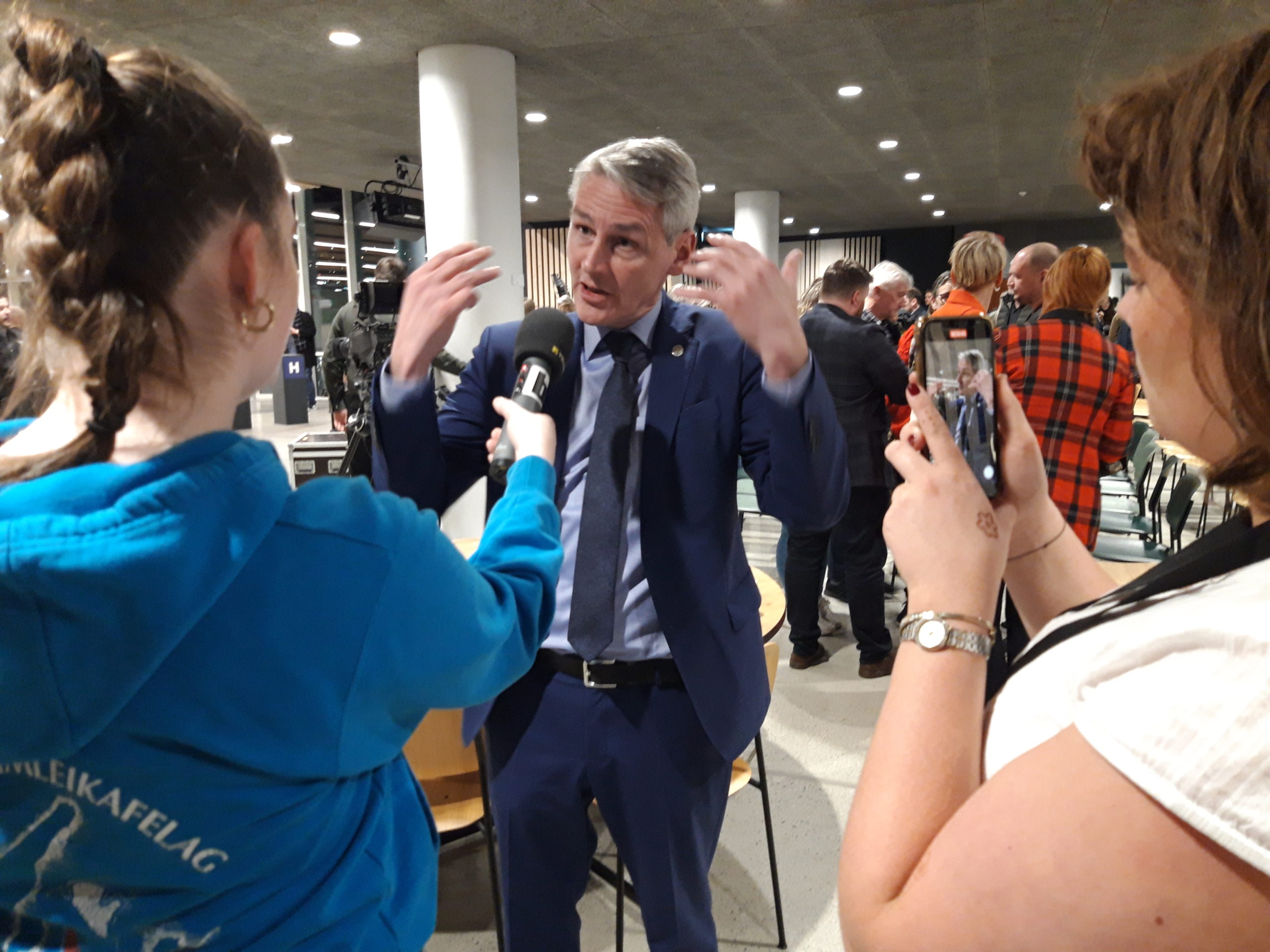
I asked why then — in the middle of the electoral campaign — he had given his support so that on November 25 the Faroe Island’s government could agree with Moscow to renew its quota swapping deal with Russia for 2023.
Hoydal and Javnaðarflokkurin, a social democratic party which had also argued for a stop to cooperation with Russia, were accused of cheap sucking up to voters from the Faroe Islands’ fishing communities, but Hoydal waved off the accusations:
“When elections were called, we were faced with another moral obligation, namely that towards the least fortunate on the Faroe Islands. To break with Russia would have in the short term enormous impact on the many families whose income depends on the cod from the Barents Sea,” he said.
He argued that duly prepared compensations to those who would lose their fishing quotas or their salary must be in place before any rupture to the deal with Russia.
“That was why we had to support the extension of the fisheries arrangement and then form a new government that can discontinue the arrangement in an orderly fashion,” he said.
Still in the car, he explained that the Faroese trawlers that are equipped to catch Russian cod in the Barents Sea cannot easily be adapted to catch the kind of fish sought by Russian vessels in Faroese waters. Unlike in Greenland, he said, difficult and expensive transitions would be needed if such transition was to be made.
In 2023, Faroese fishing vessels will have access to some 18,000 tons of Russian fish, while Russian vessels will catch fish of roughly the same value in Faroese waters. They will also reload and service their ships in Faroese harbors.
As I write, the elections in the Faroe Island are over, but the Faroe Islands still have no new government. Most likely, the leader of the social democrats, Aksel Johansen, will be the next premier of the Faroe Island.
If so, his promise to not enter into any quota swapping with Russia for 2024 unless the war in Ukraine is over will follow him into office.
Meanwhile, I learned that dissatisfaction is growing among ordinary Faroese:
“The Faroe Islands are changing. Still more people feel bad when all that seems to matter is money. Some still say that we are a very small country and that it makes no difference what we do, but most people find today that as Faroese we also have to be decent people,” said Hallbera West, an assistant professor of political science at the University of the Faroe Islands.
This text was first published on ArcticToday.com 14. December 2022.