The key to the North Pole: Russia’s hefty Arctic ambitions – and their implications for security in the Arctic
december 27, 2019 • Af Martin Breum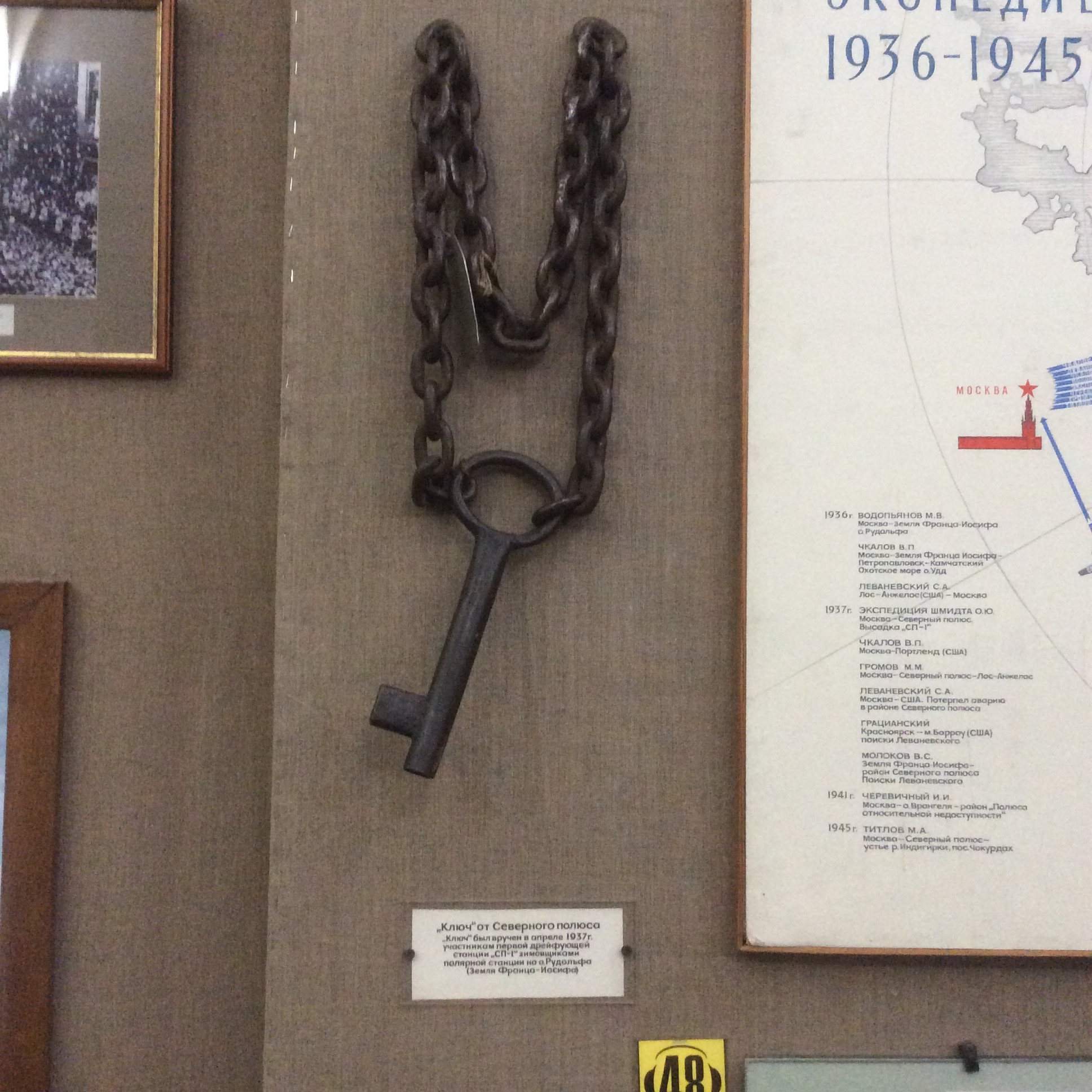
SAINT PETERSBURG — Last week at Russia’s small but magnificent Arctic museum, which has existed since 1933 in an old church in Saint Petersburg, I found the key to the North Pole — literally.
In dark and heavy wrought iron, about 20 centimeters long and coupled to an equally heavy iron chain, this ceremonial key was presented back in 1937 to the crew of Station 1, the very first of many Soviet research stations set up over the years on drift ice near the North Pole.
I will get back to the key, but for now let us accept it as a symbol of Russia’s deep attachment to the Arctic.
It helped me grasp a little more of the renewed great power rivalry in the Arctic and added to a rough outline presented to me recently by a Russian official: When the Soviet Union dissolved in 1991 and its republics and dependencies in Central Asia, the Caucasus, the Baltics and Eastern Europe were lost, Russia took some time to collect itself and then turned all eyes to the north.
In the vast and snowy provinces from Murmansk in the west to the Pacific in the east there was still plenty of room for national expansion, economic advancement, Russian greatness, scientific leaps and hopes for the future. In hindsight the turn to the north was almost destined.
“For Russia, in many aspects geography is destiny. It is very important to understand that the Arctic is an integral part of Russia’s identity and that Russia views itself as an Arctic nation,” Marya Rozanova-Smith, an Arctic researcher and lecturer tells me in Saint Petersburg.
“The Arctic is a great source of national pride in Russia and deeply rooted in its past achievements. What else does the Russian people have to be so proud of today?” she says.

Six months every year Marya Rozanova-Smith lectures on Arctic Affairs at the George Washington University in Washington D.C. The rest of the year she spends on Arctic projects at the Russian State Hydrometeorological University in Saint Petersburg, her hometown, or guest lecturing elsewhere. We met at one of the annual Arctic gatherings in Russia, the IX International Forum: Arctic – Today and the Future in a gigantic conference center outside Saint Petersburg.
Some 1,000 governors, politicians and others from Russia’s Arctic provinces and districts gathered here under 10-meter-high ceilings to learn from each other and make themselves heard by the throngs of VIPs dispatched by the central government in Moscow. Many have flown 6 to 8 hours from Yakutia, Chukotka, Krasnoyarsk or other points in the north for this opportunity; a few wear clothing of the more than 40 officially recognized Indigenous peoples in the Russian Arctic.
About a third of Russia’s land mass is Arctic and the rapid decrease in polar sea ice — and the insistent focus by President Vladimir Putin on the riches in the Arctic — has led to significant economic and military developments along Russia’s north and some 20,000 kilometers of Arctic coastline. This is an Arctic revival which changes the lives of those who live there and which provides significant backdrop for the current signs of increased great power rivalry in the Arctic.
The ice silk road
“The Arctic is the national resource base for the whole of Russia. Ultimately, it is not just about national pride, not just about identity or about the peoples living in the Arctic, but also about the country’s future economic prosperity” Rozanova-Smith says.
More than 10 percent of Russia’s GDP and some 20 percent of all Russian exports are generated in the Arctic.
The world’s first floating nuclear power station now provides electricity to the 4,000 people in Pevek, a small East Siberian town on the coast and to mining and oil operations in the vicinity.
The new nuclear-powered icebreaker Arktika, so far the largest and most powerful in the world took its first trial run from Saint Petersburg on Thursday. Its sisters Ural and Sibir will follow soon and two more have been commissioned. Beginning in April 2020 Arktika will serve the Northern Sea Route, where forward-looking shipowners, not least Chinese, are eyeing the shortest ever route between Europe and Asia, thousands of kilometers shorter than the route through the Suez Canal.
The Northern Sea Route is among the main sources of inspiration for the Russian vision of Arctic might, prosperity and future power.
The Russians have sailed on their Arctic seas and in their Arctic rivers to the hinterland since the 17the century. On some of the grimmest stretches in Siberia the icebreakers at times still fight in vain in the deep winter, but otherwise climate change has opened the waters there so that the amounts of cargo travelling here are now doubling each year.
Last May, Putin issued orders that the amount of goods travelling in the Northern Sea Route must hit 80 million tons per year in 2024. That is more than triple the current traffic, or almost 10 percent of the annual traffic in the Suez Canal, and no one here at the event in Saint Petersburg seems to question the president’s seemingly apocryphal target setting.
“Many Russians remember the Soviet era of the Arctic exploration and how they established cities and big industrial complexes in areas where you can barely survive. Russians often romanticize the Polar region and the political narratives describe it as a land of strong men, who can serve as role models for the next generations,” says Rozanova-Smith.
Stalin and other Soviet leaders used the conquering of the Arctic as proof of the invincible state. The Russians moved north (or were sent to labor camps there; those are not mentioned at the conference), while Soviet pilots in leather helmets were the first to land on the North Pole.
Rozanova-Smith takes me one more step back: “Already in the 18th century Peter the Great sensed the geopolitical importance of the Arctic. He saw Russia as a great, expanding nation,” she says.
She recounts how the emperor and his successors funded Arctic maritime explorations, including a grueling 10-year expedition from Saint Petersburg to Kamchatka with more than 3,000 men. Led by Vitus Bering, a Dane, they travelled under extreme conditions along the Northern Sea Route and eventually across what is now the Bering Strait to Alaska.
“It cost Peter the Great a sixth of the entire budget of the Russian Empire. Probably no other country has put so many human lives, so many resources and such large funds at risk for the sake of the Arctic. For other Arctic nations, that do not have the same historical legacy, perhaps the Arctic does not have the same meaning, but for Russians the Arctic will always be a land they are ready to stand up for,” Rozanova-Smith says.
At the conference in Saint Petersburg, envoys from the Arctic provinces and representatives of companies such as Gazprom, Rosatom, and Novatek explain, how harbors along the Northern Sea Route are now being deepened, railways made longer, new rails laid, pipelines constructed, shipyards expanded and billions of rubles mobilized. In November this year, Rosatom, which already manages Russia’s nuclear icebreakers, announced that it intends to buy 55 container ships for use along the Northern Sea Route.
This was another surprise for western skeptics.
In 2018, a Danish ship Venta Mærsk attracted global attention as the first ever container ship to make the trip from China to Europe along the Northern Sea Route. But Maersk Shipping, the owner, still agrees with most independent observers that running containers between Europe and Asia along the route will not be a viable business for many years to come.
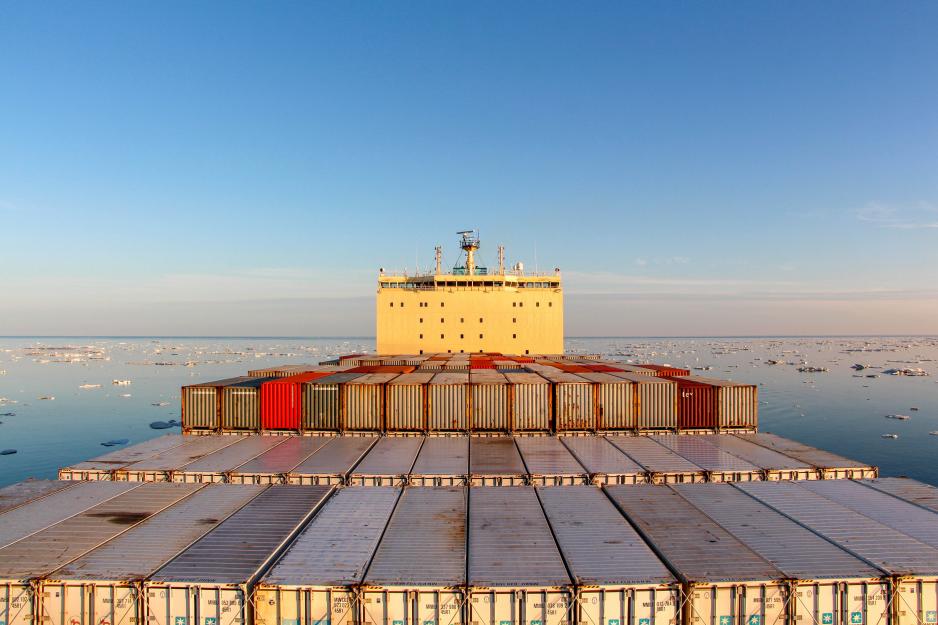
The ice still prohibits the punctuality demanded by modern customers and the hefty price on Russia’s compulsory icebreaker assistance further complicates matters. When Rosatom thinks differently, one Russian observer told me, it is most likely because the company wants to please President Putin and because it relies on domestic Russian cargo, cheap state insurance and free icebreaker service from its own fleet of icebreakers.
All this growth on the Northern Sea Route comes with a pressing security dimension. The U.S. and others accuse Russia of violating international law, by insisting that the Northern Sea Route only of internal Russian waters and that Russia is entitled to regulate — and if necessary prohibit with force — the passage of vessels from other nations. The U.S. and likeminded nations maintain that large tracts of water along the passage are international waters and the age-old right of free passage at the seas must be respected — for instance, in the case of U.S. merchant and naval vessels.
Gas for China
The largest growth in the Russian Arctic is presently from natural gas, in particular gas from the Yamal Peninsula, home of the largest deposits of natural gas in the world. From the new harbor in Sabetta on the Kara Sea, a brand new fleet of icebreaking tankers take liquefied natural gas to the world market. The huge plant at Sabetta and an a even bigger plant planned for the nearby Gydan Peninsula are presently the largest industrial projects in the Arctic. During construction of the Sabetta plant the local population grew from some 300 to 30,000.
The skeptics maintain that the huge investments in Russia’s Arctic fossil resources will prove to be less than sound as the world turns to renewable energy, but so far Russia has found plenty of interested investors and customers.
After Russia’s annexation of Crimea in 2014 and the ensuing war in Eastern Ukraine, Europe and the U.S. have to some degree turned their backs on Russia, but there are plenty of takers in Asia, where demand for natural gas surpasses that of Europe. China’s state-owned China National Production Company (CNPC), and the Chinese Belt and Road investment fund provided more than 25 percent of the 27 billion dollars it took to build the Sabetta plant and the Chinese now own 27 percent of the enterprise, while France’s Total owns 20 percent. Japan followed suit recently and made its largest ever investment in Russia — also in Yamal natural gas.
Further south but still in the frozen regions of Russia’s Far East, some 3,000 kilometers of new pipelines will transport natural gas from plants in Kovykta and Chayanada to Blagoveshchensk on the Chinese border. Chinese pipelines will eventually lead the gas to Shanghai in China’s central regions.
U.S. and European sanctions on Russia after Crimea put an extremely efficient brake on offshore oil developments in the Russian Arctic. Western oil companies have all but disappeared from the scene, and at the conference in Saint Petersburg the resulting frustrations ran thick. A plain-speaking younger official from Moscow, Magomed Gehaev, explained to a sizeable audience how Russia’s own oil sector is poorly organized and incapable of mounting any major new drilling in the Arctic without foreign technological input.
In the bigger picture, however, the potential for new discoveries remains very present in the minds of the central authorities, and the huge Prirazlomnoya platform in the Kara Sea is still the world’s only producing oil platform in such challenging ice conditions. Russia’s modern tankers, capable of breaking ice forward or backwards, carry oil from the Kara Sea to Rotterdam and other markets every day.
Military mobilization
On the military side, new missile-carrying submarines of hitherto unseen sophistication hum their way through the warmer and largely ice free waters around Russia’s naval bases on the Kola Peninsula close to Norway. Three new military icebreakers are on their way from the shipyards, also they will carry sophisticated missiles.
On the isles of Franz Josef Land only 1,000 kilometers from the North Pole Russian MIG fighter planes will soon take off from the refurbished Nagurskoye air base, the world’s northernmost military installation. The runway is 2,500 meters or long enough to receive almost all types of aircrafts and lies only a relatively short distance from the U.S. Air Force base at Thule in Greenland, with its radar — which is part of the U.S. missile defense system.
During the Cold War, the base at Nagurskoye, named after Yan Nagursky, one of Russia’s early aviation heroes, were home to numerous Russian bombers, and for the last two years the base has once again taken center stage in tensions between the US and Russia.
As the Canadian security analyst Rob Huebert puts it in the latest edition of The Arctic Yearbook:
“At the heart of the problem is a geographical proximity of the Soviet/Russian and American location connected by the Arctic region. This is combined with the existing weapon systems that place a premium on the Arctic as the best staging location for strikes against each other.”
“Thus it is not about an appearance of a new Cold War, it is simply the resurfacing of the ‘old’ Cold War,” he writes.
In November a MIG fighter plane exercising above the Barents Sea launched one of Russia’s new hypersonic Kinzhal missiles, which flies some eight to 10 times faster than all previously known ballistic missiles. Security analysts say that Russia’s Kinzhal and Zhirkov missiles are so fast they will penetrate any known missile defense systems, including that of the US. President Putin has bragged about them in the Russian media, but in Saint Petersburg we are told that Russia’s Arctic military build-up is of course only there to maintain a deterrence against foreign (read: U.S. and NATO) aggressions and to defend Russia’s new assets in the Arctic. The head of Russia’s mighty Northern Fleet, vice admiral Aleksandr Moiseyev took the floor himself to make this very point (as relayed through the conference translators:)
“The Northern Fleet is the most powerful force in the world and our presence is a guarantee of peace in the Arctic. We seriously believe that no conflict will arise in the Arctic. For me that is the main priority. Our defensive missile systems are for the defense of our national interests,” he said while showing pictures and graphs of it all.
Denmark and Greenland’s role
The message from the Moscow authorities at the Saint Petersburg event was unambiguous: Russia’s leadership will continue to invest itself and its political and economic capital in the Russian Arctic.
And as we should not forget, Russia also stands to win the rights to substantial new parts of the seabed in the Arctic Ocean towards the North Pole simply by abiding by international law, namely the UN Convention on the Law of the Sea.
Russia therefore has very much to lose and very little to gain from unrest, tension and conflict in the Arctic — or at least that is how Russia’s currently explains Arctic security. The central points were repeated recently at a public event in Copenhagen by Russia’s ambassador to Denmark, Vladimir Barbin, who was Russia’s primary Arctic diplomat for five years before taking up his post in Copenhagen.
European analysts, including analysts here in Copenhagen where I am based, have long tended to agree to most of this analysis and it still informs the latest Arctic analysis from the Danish Defence Intelligence Service, published in November: “Russia (has) an interest in maintaining stability and peace in the Arctic. This will benefit Russia’s security and economic interests in the region and create the most favorable conditions for negotiations for maritime delineation,” the report reads (my translation).
At the same time, however, significant adjustments towards a more hawkish approach to Russia seem to take sway here as well as in Norway, another Arctic country, which is much closer to Russia and deeply involved in renewed Arctic mobilization along the U.S. and Great Britain.
U.S. and British troops have been for the last year more or less permanently stationed in the Norwegian Arctic, and in Denmark our prime minister Mette Frederiksen recently announced a doubling or more to the budget of Denmark’s Arctic Command in Greenland. This followed U.S. complaints that Denmark is not doing enough in the Arctic, and in announcing the budget increase our prime minister made specific reference to Russia: ”We see a significant increase in Russia’s Arctic presence in the Arctic. This is why we need increased anti-submarine capacity. Secondly, we see increased Russian activity in the air. Therefore we need to make particular efforts in the air. Monitoring of our airspace by radar, satellite and planes is one option,” she said. “We have a special responsibility, and we need to lift that. There is reason to be vigilant. The Arctic is a low tension region and we want it to remain so. But should not be naive,” she told (my translation) Berlingske, a major daily newspaper.
As many will know, this followed U.S. President Donald Trump’s confirmation in August that conversations had been ongoing for some time at the White House about how the U.S. might possibly buy Greenland from Denmark. This was a tangible signal of the rapidly increasing strategic U.S. interest in the Arctic, spurred not the least by the Russian military build-up.
The trend of course is likely to continue, just as the Russian focus and dependence on economic growth in the Arctic will continue. Which is why the key to the North Pole at the museum in Saint Petersburg and the particular relationship between Russia and the Arctic, which it represents, calls for renewed attention.
As I now know from Mikhail Lamakin, deputy director for scientific work at the museum, the key to the North Pole was presented to crew of SP1, the first Russian drift ice research station, by the workers of another research station, Ostrov Rudolfa, located on Franz-Josef Land some 1,000 kilometers from the North Pole.
The island station was the key base for preparations before the crew of SP1 took off for the ice. During 1936 they built airfields and storage facilities around Rudolfa station and in May 1937 four large cargo planes carried the crew and their gear onto the ice near the North Pole and left them there to hoist the Soviet flag, turn the key and do their job.
This was successfully completed in February 1938, some 274 cold days later, as the ice broke up and the crew was evacuated by ship.
—

