>
Søg efter dato

januar 2019

blog

Plastic pollution increasing at the top of the Earth

januar 26, 2019 • Af

Increasing amounts of plastic pollution is being detected in Europe’s most northern Arctic regions. This week in Tromsø, I learned how scientists are registering high concentrations of microplastic particles not only in Arctic waters but also in the Arctic ice and snow. Indications are that plastic pollution has reached the still ice-encapsulated North Pole, thousand of kilometers from human habitation.

“Our latest knowledge indicates that plastics really are everywhere now. It is difficult to find anywhere in the Arctic that is not affected, and there is no way to remove microplastics from neither the ocean, the ice or the snow,” senior researcher Dorte Herzke from the Norwegian Institute for Air Research told me.
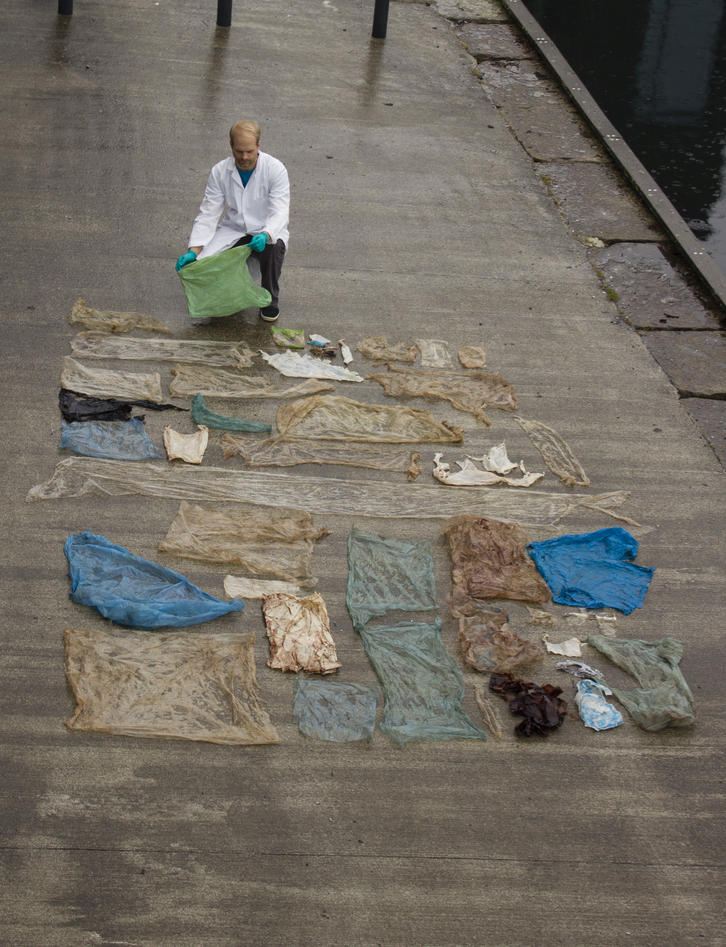
More than 30 plastic bags were found in the stomach of a beached Cuvier’s beaked
whale in Norway in 2017. Scientists blamed the garbage for the whales death. Photo:
Christoph Noever / University of Bergen

New scientific evidence of plastic litter in the Arctic was presented earlier this week in Tromsø, the main city of Norway’s Arctic north.

Frustration in the sparsely populated Arctic is growing as the overwhelming majority of the plastic litter stems from other parts of the world:

“The debate changed completely two years ago, when we had a whale that came ashore, its belly full of plastic bags. Everyone realized that this was something the whale had gotten into its stomach on its long travels. It brought to our attention that many of the countries that are most affected by marine litter do not produce that litter themselves,” Norway’s foreign minister, Ine Marie Eriksen Søreide, said. Søreide and several other government officials attended this years so-called Arctic Frontiers conference in Tromsø designed to bring science and politics together.

Marine plastic pollution, much of it garbage from the Asia-Pacific region but also from Europe, is pushed into the Arctic seas by global ocean currents, but scientists are also increasingly detecting microscopic plastic particles brought to the Arctic by long-range winds. Falling snow washes these microscopic plastic fragments into the ocean or deposits them on the ice-cover on the oceans.

We can basically follow this concentration of plastic from the atmosphere down through the ice, through the water column and to the sediments on the ocean floor. And don’t forget this is in the Arctic which is already under threat from significant climate change,“ Dr. Ilka Peeken told med. She is a sea-ice ecologist of the Alfred Wegener Institute Helmholtz Center for Polar and Marine Research, Bremerhaven, Germany.

During cruises with Polarstern, a research vessel of the Alfred Wegener Institute, Peeken and her colleagues drilled cores from ice-floes, some originating as far north as the Makarov Basin in the central part of the Arctic Ocean close to the North Pole. These cores contained “an extremely high number” of microplastic particles, she said.

She now worries that plastic will affect the fragile eco-system in the Arctic: “My own theory is that the sea-ice itself further fragments the plastic into even smaller particles. Because sea-ice is so cold, the so-called brine channels in the ice gets very salty, and the salt may further fragments the plastic“ she said.

If proven, this may present a new layer of environmental dilemmas:

“The problem is that the smaller the particles get, the more damage they may do. Today, we talk of nano-plastics where the particles are so small that they can penetrate cells, and there are studies to suggest that they might cause cell damage” Peeken said.    

Norway’s Special Representative for the Oceans, Vidar Helgesen, pointed to the EU as a significant ally:

“The EU’s plastic strategy and its circular economy package is very important. Norway is part of the single market and we welcome common European approaches. The EU-ban on single-use plastics will have a tremendous effect, because the EU is such a big market,” he told me. 

The European Parliament’s Environment Committee this week approved new EU rules on plastic pollution proposed by the EU Comission, including a complete ban on some single-use plastic products often found on European beaches.

As for saving the Arctic against more plastics, Vidar Helgesen, who formerly served as Norway’s Minister for EU Affairs, was only cautiously optimistic:

“I am not sure that in ten years we will have less plastics in the oceans than we have today, but the flow of plastics into the oceans will be smaller. The attention to the issue among the electorate and at the highest political level is a good sign, but sadly we will see for a number of years increased plastic in the oceans before new measures will take effect. You have a number of countries particularly in the Asia-Pacific where it is critically important to get waste management systems into place and where it will take time,” he said.

Scientists stress that studies of plastics in the Arctic are still few and that they still have more questions than answers. A new scientific research project in Tromsø will aim particularly at plastic pollution and Norway is stepping up diplomatic efforts to stem the global tide of plastic litter; an initiative closely linked to Norway’s plans to increase exploitation of marine resources including oil and gas, subsea minerals, fisheries, aquaculture, shipping and tourism.   

“If we are to succeed at creating the jobs of the future and solve the global challenges we have no other choice than to release the enormous potentials of the ocean,” Norway’s Prime Minister Erna Solberg wrote in an op-ed on Highnorthnews.no just prior to this week’s Arctic Frontiers conference.

A total of five government ministers insisted in Tromsø that increased exploitation of the seas, including more oil drillings in Norway’s Arctic seas, can be done sustainably — an argument hotly disputed by environmentalists and some scientists.     

Prime Minister Erna Solberg last year launched a global High Level Panel for a Sustainable Ocean Economy Panel, which includes (as the only member from an EU country) Portugal’s Prime Minister António Costa as well as leaders from Australia, Chile, Fiji, Japan and other countries. Erna Solberg’s stated objective is three-pronged – to “produce, protect and prosper”.

Dette indlæg blev først bragt på EUobserver.com 25. januar 2019. 

blog

Her er den egentlige forskel på dansk og grønlandsk syn på fremtiden

januar 18, 2019 • Af

En ny undersøgelse af grønlændernes holdning til løsrivelse fra Danmark afdækker en afgrundsdyb forskel på, hvad danske politikere forestiller sig, og det som en tredjedel af vælgerne i Grønland forventer af Grønlands eventuelle løsrivelse. Mens danske politikere gerne fortæller, hvordan Grønland vil opleve et dramatisk drop i velfærden, hvis løsrivelsen skulle blive en realitet, er en stor del af den grønlandske befolkning overbevist om, at løsrivelsen vil gavne den grønlandske økonomi og dermed deres egne livsbetingelser.

På vej til fremtiden – store dele af grønlænderne mener, at løsrivelse vil være godt for økonomien. Foto: Martin Breum

Undersøgelsen, der er lavet under kyndig vejledning af professorerne Minik Rosing og David Dreyer Lassen på Københavns Universitet, dokumenterer først, at 67,7 procent af alle voksne bosat i Grønland ønsker, at Grønland på et eller andet tidspunkt i fremtiden bliver en uafhængig stat løsrevet fra Danmark.

Den del af undersøgelsen vil næppe overraske mange på Christiansborg. To gange tidligere har et lille analysefirma i Nuuk, H.S. Analyse, vist tilsvarende opbakning til visionen om løsrivelse. Det nye i undersøgelsen er, at den viser, hvordan 43,5 procent af de grønlandske tilhængere af løsrivelse mener, at en afslutning på rigsfællesskabet, som vi kender det, vil have “positiv” eller endog “meget positiv” indvirkning på Grønlands økonomi. 62,3 procent af dem, der siger at de ville stemme ja til løsrivelse, selvom løsrivelsen skulle finde sted straks, mener, at løsrivelsen ville medføre forbedringer af økonomien. 

Det har vi ikke før haft dokumentation for, og man kan hurtigt opregne flere grunde til, hvorfor danske politikere formentlig kan have glæde af at spekulere lidt videre over den nyhed.

For de grønlandske politikere er det formentlig tankevækkende, at der er så stor forskel på forventningerne til løsrivelsen i Grønland. Blandt modstanderne af løsrivelsen mener 79 procent nemlig, at løsrivelsen vil have “negative” eller “meget negative” konsekvenser.

Der er med andre ord og uanset, hvad man selv mener, en oplagt risiko for at splitte den grønlandske befolkning i to grupper med meget forskellige fremtidsopfattelser. Man behøver blot at tænke på Brexit og den lammelse, der har ramt Storbritannien, for at ane, hvor destruktivt en sådan kløft kan udvikle sig.

For den videre dansk-grønlandske diskussion kan vi konstatere, at 43,5 procent af alle tilhængerne af løsrivelse i Grønland er meget langt fra at være enige i den analyse af løsrivelsens potentielle konsekvenser, der ofte lægges til grund i Danmark.

Statsminister Lars Løkke Rasmussen og andre har fra folketingets talerstol gerne gjort opmærksom på, hvordan 52 procent af de offentlige udgifter i Grønland fortsat finansieres af det årlige bloktilskud fra Danmark. Og så føjer de gerne til, at Grønlands søgrænser, politivæsen, fiskerikontrol og redningstjeneste fortsat opretholdes uden mange omkostninger for Grønland blandt andet i kraft af det danske forsvars Arktiske kommando og de tilhørende fly, skibe og det specialiserede mandskab. Denne faktaboks bruges af danske politikere i mange forskellige aftapninger; den kan uddybes i detaljer om plejehjem, skoler, børneomsorg og andre velfærdsgoder, som angiveligt vil mangle, hvis bloktilskuddet engang skulle blive blokeret, fordi grønlænderne vælger at løsrive sig.

På samme måde — omend med mindre direkte politisk fortolkning – leverer  Grønlands Økonomiske Råd, ofte repræsenteret ved Rådets formand, den tidligere overvismand i Danmark, Torben M. Andersen, løbende analyser og kommentarer, der viser, hvordan Grønlands økonomi skal forbedres markant, hvis det hele skal hænge sammen på lidt længere sigt; senest præsenterede Torben M. Andersen analysen på den årlige Grønlands-konference i DI.

Torben M. Andersen afholder sig som professionel økonom selvfølgelig fra at mene noget om, hvorvidt Grønland skal løsrive sig eller ej, men Rådets analyser følger samme logik som de danske politikeres. Logikken lyder, at der er så mange udfordringer for langtidsholdbarheden af den grønlandske velfærd, at det selvsagt ikke nytter at rokke for meget ved båden — for slet ikke at tale om at løsrive Grønland fra det åndedrætsopholdende bloktilskud fra den danske statskasse.

Problemet for dialogen mellem Danmark og Grønland er altså ikke —  ved vi nu fra den nye undersøgelse — er at mere end 40 procent af løsrivelsestilhængere i Grønland ikke har fæstet nogen lid til den analyse, der er den gængse i Danmark. De ønsker ikke bare løsrivelse i en eller anden paradoksal trods af den analyse, der dominerer i Danmark; de simpelthen dybt uenige i selve analysens substans.

Graferne i den nye videnskabelige undersøgelse taler deres eget, tydelige sprog: Blandt de 38,4 procent af vælgerne, som ville stemme ja til løsrivelse straks, mener 27,7 procent, at løsrivelse vil have “meget positiv” indvirkning på den grønlandske økonomi, mens 34,6 mener, at effekten vil være “positiv”. Jeg tillader mig at gætte, at en væsentlig del af de samme mennesker faktisk mener, at tilhørsforholdet til Danmark ligefrem er en byrde for den grønlandske økonomi. Det er ikke præcist det, tallene viser, men forestillingen om, at det dansk-grønlandske forhold i økonomisk forstand er til dansk fordel (og i øvrigt længe har været det), har man kunne møde i Grønland længe, og den forestilling har den danske, politiske retorik altså tilsyneladende ikke rokket ved.

Det efterlader en afgørende kløft i dialogen, som ingen hidtil har anvist nogen umiddelbart farbar vej over.

Vi ved ikke, hvordan respondenterne når frem til analysen af de forventede, økonomiske konsekvenser af løsrivelsen. Men undersøgelsen hjælper til at forstå, hvorfor partier, der argumenterer for løsrivelse, lige siden de politiske partiers historie begyndte i Grønland, har høstet den overvejende del af stemmerne, når der er valg i Grønland.

Tallene viser en lidt større opbakning til visionen om løsrivelse i bygderne langs kysten end i de lidt større grønlandske byer. De viser også, at opbakningen er lidt større blandt de grønlændere, der opfatter sig selv som mindre velstående, end blandt dem, der mener, at de i økonomisk forstand har det lidt bedre. Det er ikke store forskelle, men de svarer nogenlunde til den almindelige antagelse, der har været gældende i Grønland i nogle år, nemlig at de løsrivelsesivrige partier har lidt større opbakning blandt vælgerne i de mindre kystsamfund, hvor der er mange fiskere og fangere, end i byerne, hvor der er relativt flere lønmodtagere og folk med formel uddannelse.

Ligesom deres vælgere, synes heller ingen af de toneangivende aktører i grønlandsk politik at dele den økonomiske analyse af løsrivelsens potentielle konsekvenser, der oftes lægges til grund i Danmark.

Der er ingen af de ledende politikere i Grønland, der argumenterer for, at befolkningen i Grønland bør acceptere en nedgang i levestandarden til gengæld for hurtige skridt mod løsrivelse. Velfærdssamfundets vedligeholdelse er i Grønland såvel som i Danmark blevet en fast del af al politiks mål, og det rokker visionen om løsrivelse ikke ved. Politikerne fastholder i stedet mere eller mindre implicit, at løsrivelsen vil styrke Grønland, frisætte flere kræfter, skabe initiativ, nyt mod og fornyet innovation både i det private og i det offentlige, herunder til omlægning af den ganske store, offentlige administration i Grønland, der sluger en pæn bid af det offentlige budget, og som i mange politikeres øjne er en noget klodset klon af den danske centraladministration.

På samme måde kan man også møde det argument, at  løsrivelse vil gøre det nemmere at inddrage de svageste mere aktivt i samfundslivet, fordi de efter løsrivelsen i højere grad vil føle sig anerkendt, blive set og hørt — også selvom de ikke taler dansk.

Den nuværende finansansvarlige i Naalakkersuisut, det grønlandske landsråd, Vittus Qujaukitsoq, gjorde under seneste valgkamp i det tidlige 2018 klart, at han var parat til at acceptere en vis nedgang i levestandarden i Grønland, hvis det var nødvendigt for at fremskynde løsrivelsen, men det var en enlig svale. Han fulgte det ikke op med detaljer, og det var ikke et udsagn, der vakte større furore. Opstanden over denne fravigelse fra hovedreglen udeblev, muligvis fordi Qujaukitsoqs overraskende melding lå fjernt fra den gængse politiske logik i Grønland, som også Vittus Qujaukitsoq som mangeårigt medlem af Siumut, det gamle regeringbærende parti i Grønland, længe har repræsenteret. Qujaukitsoq stiftede fort før valget i april sit eget parti, Nunatta Qitornai, men han opererer i tæt koalitions-symbiose med formanden for Naalakkersuisut, Kim Kielsen, der også er formand for Siumut, og i den alliance har tanken om at give køb på skoler, plejehjem og børneomsorg til gengæld for et hurtigt ryk mod løsrivelsen ingen plads. Løsrivelsen ses snarere som et værktøj til større eller i hvert fald vedligeholdt velfærd, ikke det modsatte. Der findes endnu ingen offentliggjorte, teknisk-økonomiske analyser, der dokumenterer, at løsrivelse ville styrke økonomien, men vi ved nu, at den antagelse har godt fat i vælgerkorpset.

Den nye holdningsanalyse blev offentliggjort i Nuuk i begyndelsen af december. Den  gennemføres af de to ph.d.-studerende: Kelton Ray Minor, der forsker ved Kraks Fond Byforskning og Centre for Social Data Science (SODAS) på Københavns Universitet, og Gustav Agneman fra Økonomisk Institut i Købehavn. De to og fire forskningsassistenter fra Ilisimatusarfik, Grønlands Universitet, opsøgte over to måneder i sommer 606 voksne i 13 byer og bygder fra nord til syd i Grønland, og bad dem udfylde et spørgeskema. Alle respondenter var nøje udvalgt af Grønlands Statistik, der sikrede et repræsentativt udvalg af unge, gamle, by- og bygdeboere. Undersøgelsen viser også, hvordan grønlænderne oplever klimaforandringerne, fiskeriet og udsigterne til minedrift i Grønland. En større rapport med flere tal og analyser ventes til februar. Undersøgelsen er en del af forskningssamarbejdet Greenland Perspective mellem Ilisimatusarfik, universitetet i Nuuk, og Københavns Universitet.

Dette blogindlæg blev i sin oprindelige version bragt som nyhedsanalyse på Altinget:Arktis 9. januar 2019. Den oprindelige tekst indeholdt en unøjagtig fremstilling af flere tal. Både tekst og tal er siden blevet korrigeret. 

Skulle du have lyst til at se, hvordan de første resultater af den nye meningsmåling blev lanceret i Nuuk, ligger hele begivenheden på Youtube. De resultater, der er omtalt ovenfor, præsenteres i den sidste del af seancen:


blog

Did anyone talk about the Arctic at COP24?

januar 2, 2019 • Af

I keep wondering if anyone really talked about the Arctic in Poland at COP24, the great international climate meet that recently ended? This was for a brief moment the world’s most important arena for the battle against climate change, designed to get the Paris Accords from December 2015 on track — but where was the Arctic?

Looking back at two weeks of intense global media coverage, I wonder where were the heads of states from the Arctic countries blasting away about the effects of climate change in the Arctic?

Where were the key ministers from the eight Arctic governments banging fists against podiums to fuel important speeches about the challenges to the Arctic peoples, the villages ravaged by coastal erosion, the threats to biodiversity, the decimated herds of reindeer, the melt of Greenland’s ice sheet and of sea ice in the Arctic Ocean, the buckling infrastructure, the heating oceans, the melting permafrost and how the changes in the Arctic will affect the entire globe?

And indeed, where was the Arctic Council? The body that the Arctic governments so often praise as their common platform, our successful melting pot of good intentions, strategic diplomacy and inclusive Arctic governance? How many times have the Arctic Council issued statements on the need for action against climate change? So why did the new Secretary General of the Arctic Council not stand up in an epic moment, devoid of all falsehood and pretense, to face the cameras and tell the world how the eight Arctic governments had asked her to first of all ask for two minutes of silence — and then go on to declare, on behalf of the eight nations and all the indigenous Arctic peoples, that as from this moment all political activity in these eight Arctic states —  including Russia and the USA —  would be drastically re-designed and focused singularly on the prevention of further, catastrophic heating of the planet — and richly inspired, of course, by the consistent work of the five scientific working groups of the Arctic Council, encompassing hundreds of the most dedicated scientists of this world, who have already long ago documented how urgent action is sorely needed. And excuse us, by the way, for not doing this long ago.

‘No talk about climate’

Sometimes it is good to allow oneself a bit of wanderings like this.

I know of the limits to the mandate of the Secretary General of the Arctic Council and, more importantly, the absence of wider commitments to climate efforts in capitals like Moscow and Washington.

But the absence of newsworthy Arctic interventions from political leaders of USA, Russia or other Arctic states at COP24 in Poland reminds us how climate change in the Arctic does not seem to be what drives the agenda for many key political leaders in the Arctic capitals.

The governments of the Arctic are concerned about sustainable development, which is something quite different. Indeed, few know exactly what the term means, but the governments mostly agree that it does not compel them to focus more seriously on climate change, even if the problem is certainly there in the statements of intent.

The Moscow government has recently announced yet another larger-than-life 5.5 billion-ruble investment plan for the Russian Arctic. A colleague from The Independent Barents Observer in Norway travelled with Russian prime minister Medvedev to the booming oil and gas-center in Sabetta in Russia’s far north Yamal Province to report how the new plan covers “investments in regional infrastructure and natural resource development, including railway construction, new sea ports and development of hydrocarbon and coal fields….There was no talk about the aggravating and potentially devastating climate changes that are unfolding in the Arctic. The meeting headed by Medvedev had its focus not on nature protection, but on exploitation.”

In Alaska, on the U.S. side of the Bering Strait latest news is the revitalizing of plans for a new 200-mile highway to copper fields in the far north — and a rush to drill for more oil in more places on the North Slope, including a long-fought-over wildlife refuge; probably to no-one’s surprise. Economic development has been for years on the top of the agenda of many Arctic communities, and the governments of the Arctic countries have been quick to incorporate this natural desire of the peoples of the Arctic into comprehensive, national strategies for future growth.

Teenager steals the attention

The governments of the Arctic states are home to the most glaring evidence of climate change available on the planet. They are rich in economic resources, in technology and knowledge; they have financed for almost three decades substantial science into just about any aspect of climate science in the Arctic, including science conducted by the Arctic Council’s productive scientific working groups. Hundreds of scientific articles, reports and carefully calibrated suggestions for action have been crafted by scores of conscientious experts from across the Arctic — and yet no-one from the governments of the Arctic really stood up to present all this in Poland. The science by the working groups is of course carefully integrated into IPCC’s reports, but is is not boosted in very visible ways by political leaders.

The Arctic Council, to be fair, was certainly not absent in Poland. The Arctic Council and the government of Finland, which is presently chairing the Arctic Council, co-hosted a 90-minute side event for all interested parties to attend on the heady effects of black carbon in the Arctic. An obvious item for the global audience at COP24. Black carbon, which is basically soot from industries, power-plants, gas-production, cars and households in Europe, the U.S. and Asia, is darkening ice and snow in the Arctic, so that the Arctic absorbs more of the sun’s warmth than before. At the event, starred by the environmental ministers from both Finland and Poland, experts told the audience how this heavy source of climate change could fairly easily be extinguished using existing technologies, and a representative from the Climate and Clean Air Coalition told of worldwide efforts to curb black carbon emission.

Meanwhile, 15 year old Greta Thunberg from Sweden stole much of the media attention at COP24 with a three-minute speech. In carefully braided pigtails she faced the global gathering of ministers, diplomats and negotiators of all hues and gave them all she had: “You only speak of green eternal economic growth because you are too scared to be unpopular. You only talk about moving forward with the same bad ideas that got us into this mess,” she said.

I understand that diplomacy is about finding compromise in the real world. I know that it will most probably never happen, but quietly, I allow myself to wonder if any key political representative of a key Arctic government will ever speak about the Arctic with similar nerve.


This blog was first published on ArcticToday.com  26. December 2018